|
Meteorites from Asteroids
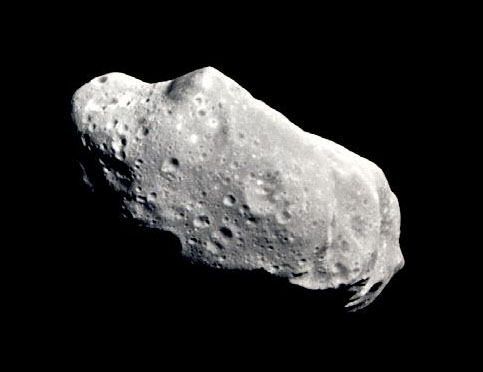
Iron meteorites like the Sikhore-Alin come from asteroids, which are large rocks that orbit the sun in the same way that planets do. Over a million asteroids travel in a band or "belt" between the planets Mars and Jupiter. The asteroid that scientists have named Ida is a good example. It is irregularly shaped (instead of round like a planet), and it is about 33 miles long from end to end (--a very big rock, but certainly much smaller than a planet).
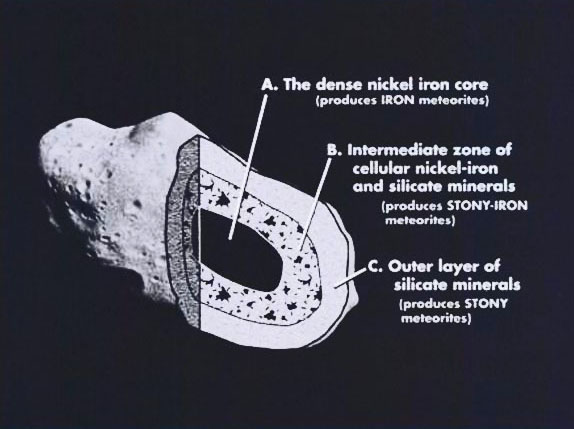
If we were able to cut away a section of such an asteroid, it would reveal several layers. On the outside there would be a stony layer. Beneath that would be a layer of heavier rock containing a significant amount of iron. Then at the core of the asteroid would be a very dense center composed almost entirely of iron with a little of the metal named nickel and only small amounts of other elements. Meteorites like the Sikhote-Alin come from the cores of asteroids. (Some meteorites contain less iron than Sikhote-Alins and would come from the middle or outer layers of asteroids.)
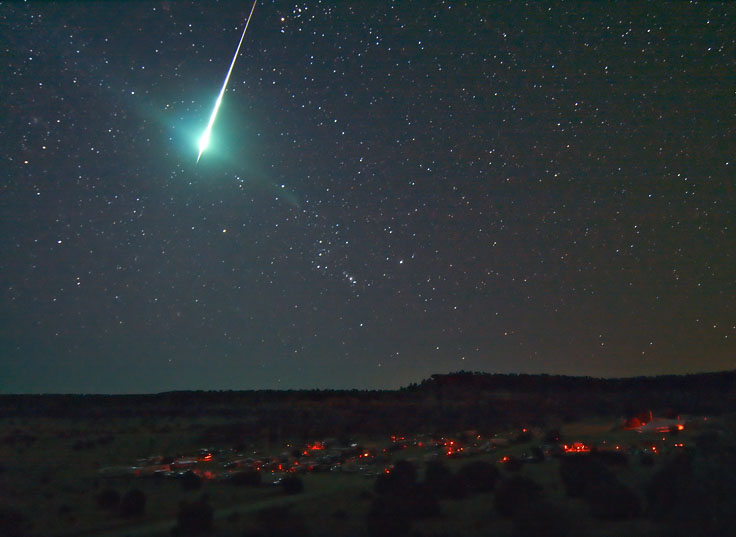
So, if meteorites come from asteroids, how do they get from the Asteroid Belt to the Earth? The answer is that an asteroid must somehow be pushed out of its orbit, and that could happen most easily if one asteroid hits another one. The impact would not only change the asteroid's course, but it could be strong enough to shatter the rock into many pieces, releasing even parts of the core to fly free as chunks of iron. When these pieces of an asteroid happen to fly near the Earth, our planet's gravity pulls them in, and they fall at great speed through our atmosphere. Traveling so fast as they plummet to earth, they become very hot. Most burn up, and sometimes we see these as streaks of light or occasionally balls of fire in the night sky. When a piece of rock from space enters our atmosphere, we call it a meteorite.
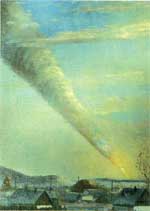
An iron meteorite like the Sikhote-Alin was big and dense enough to survive the trip through the Earth's atmosphere. Even though a lot of it burned up in the air, and the heat caused it to explode into many fragments, much of it was still able reach all the way to the ground with a spectacular trail of smoke and fire visible in daytime.
Most meteorites are the remnants of asteroids from the Asteroid Belt. The Sikhote-Alin fall helped scientists to figure that out, because eyewitnesses were able to report important observations, like the angle in which it fell --and that helped indicate the path by which it came to the Earth. By studying these rocks from space, we also learn a great deal about our own planet. Iron meteorites like Sikhote-Alin, from the core of asteroids, have given us clues about what the very center of the Earth is probably like. When you hold a Sikhote-Alin meteorite, you hold a piece of rock that once was deep inside an asteroid that floated in space beyond Mars --a piece of the heavens that journeyed over 100,000,000 miles from the Asteroid Belt, happened to wander into Earth's orbital path, and survived a fiery descent through our atmosphere. These rocks are cosmic travelers.
|